









To Get Updates on Course Launch: Register Now

"*" indicates required fields

Name*
DevSecOps Essentials
CERTIFIED PROFESSIONALS IN 150 COUNTRIES

EC-Council Essentials Series

Cybersecurity is a multifaceted industry with several specialized domains, each demanding unique skills. Choosing the right domain to start your cybersecurity career can get challenging.
EC-Council brings the Essentials Series to help you develop the foundational skills that are right for you. This Essentials Series is a set of hands-on, immersive courses to help you learn solid technical foundational skills in various cybersecurity fields, ensuring that it is highly affordable. Specially designed for high school students, fresh graduates, career switchers, starters, and IT or technology teams with little or no experience in IT/cybersecurity, this series aims to help you start your career in cybersecurity. These courses will help you learn about several aspects of cybersecurity, allowing you to discover your areas of interest and develop foundational job-ready cybersecurity skills.
The EC-Council Essentials Series covers eight courses focused on fundamental skills – Ethical Hacking, Network Defense, Digital Forensics, Cloud Security, IoT Security, SOC, Threat Intelligence, and DevSecOps.

EC-Council DevSecOps Essentials

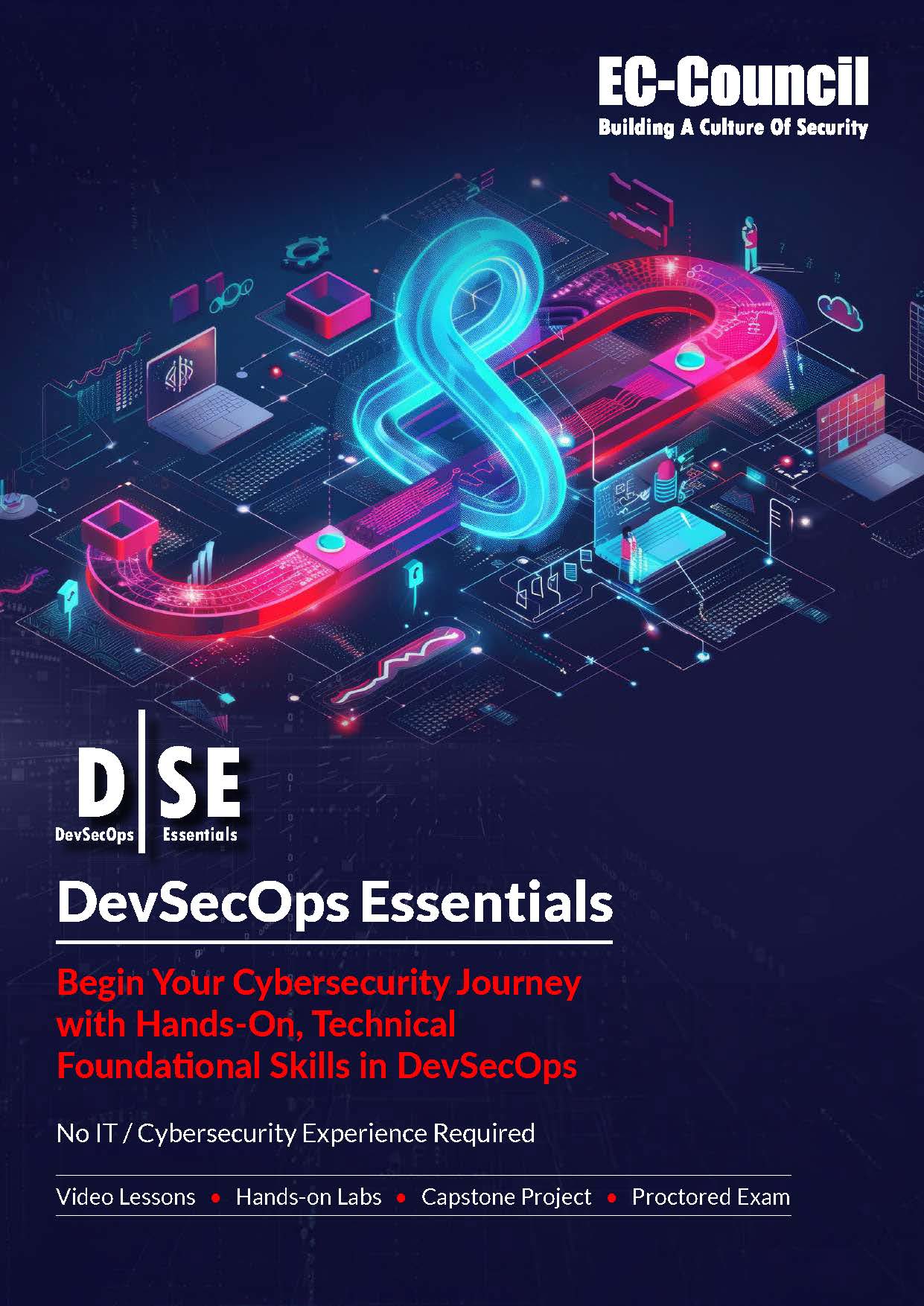
The DevSecOps Essentials (DSE) covers fundamental skills in DevSecOps, providing key insights into identifying application development risks and securing and testing applications within on-premises, cloud providers, and infrastructures. No IT/Cybersecurity experience required for this course.

Test your skills with Capstone Projects and validate these newly acquired skills in proctored exams. With 7 practical labs, 7+ hours of premium self-paced video training, and 10 modules, it ensures students gain recognition and secure better opportunities for the next logical step after DSE.

The DevSecOps Essentials program will provide you with the foundation knowledge and essential aspects of secure application development, or DevSecOps. In this course, you will gather key insights into identifying application development risk and securing and testing applications within on-premises, cloud providers, and hybrid infrastructures. In capstone project demonstrating your ability to think critically, apply acquired knowledge, and employ hands-on skills to resolve a variety of challenges. After completing this program, you will be prepared to move toward a career in secure application development. If you are looking to learn an advance DevSecOps certification, click here: EC-Council Certified DevSecOps Engineer (ECDE)

Key Features of the DevSecOps Essentials Program

DevSecOps Essentials (DSE) Program Information

Why EC-Council Essentials Series is the Most Popular and Fastest Growing Beginner-Level Training Program for Freshers and Career Switchers

213,000+

Learners Trust
EC-Council’s Essentials Series

150+

Countries

85+

Million Minutes Watched

4.95/5.0

Average Ratings

96.46%

of Learners Gave a 5* Rating

Why Do Professionals, Students, Career Starters and Changers Worldwide Choose the EC-Council's Essentials Certification?

Learn Foundational Cybersecurity Skills with EC-Council’s 8 Essential Series

EHE

Ethical Hacking Essentials

NDE

Network Defense Essentials

DFE

Digital Forensic Essentials

CSE

Cloud Security Essentials

DSE

DevSecOps
Essentials

ISE

IoT Security
Essentials

SCE

SOC
Essentials

TIE

Threat Intelligence Essentials
Essential Series for Enterprises

Empower Your Teams

With Strong Technical Foundational Skills to Secure Your Organization
Essential Series for Educators
Secure Your Students Career
Partner with EC-Council and Help Students Develop Diverse Essential Skills to Kick-Start their Careers

FAQs

When security integration is involved in every step of the software development process, it is
called DevSecOps—which stands for Development, Security, and Operations. With DevSecOps,
SDLC becomes easier and less expensive to fix vulnerabilities.

DevOps focuses on successful software delivery, but DevSecOps primarily focuses on securely implementing software development lifecycle reducing vulnerabilities. Hence, DevSecOps is a more secure and better choice than DevOps.

Upon completion of the 12 hour DSE course and passing the proctored exam, EC-Council will
certify you for the DevSecOps Essentials program.

The software for your system should be the latest version of Atom IDE and have Node.js LTS 8.9.1 installed for attending the EC-Council Essentials DevSecOps course.

Upon completion of the DSE course, apply for the ECDE course offered by the EC-Council. ECCouncil’s Certified DevSecOps Engineer course will equip you with the required cybersecurity
skills to become an expert DevSecOps professional.

Yes, EC-Council’s DevSecOps Essentials course is for beginners. High school or university students can apply with or without prior work experience.
Over 2 lakh students trust the EC-Council Essentials Series in 150 countries. Popular for its wide topic coverage, it also offers students and professionals the chance to kickstart their cybersecurity careers with job-ready skills and gain global recognition.

After completion of the DevSecOps Essentials course, you can further enhance your DevSecOps
skills by applying to the EC-Council’s Certified DevSecOps Engineer (ECDE) course offered by
EC-Council.

The EC-Council DevSecOps Essentials is available in separate pricing plans for individuals,
universities, and enterprises. Enquire here for more information on the DSE course plans and
prices.

To start a career in DevSecOps, you can apply for EC-Council’s DevSecOps Essentials course, an introductory cybersecurity course that equips you with the foundational technical skills sought by employers, making you eligible for entry-level roles. It will provide you with key insights into identifying application development risks and securing and testing applications within onpremises, cloud providers, and hybrid infrastructures.

Depending on your interests in various aspects of cybersecurity, you can begin your career with
EC-Council’s Essentials course. It offers eight different training courses – EHE for fundamentals
of Ethical Hacking, NDE for the basics of Network Defense, DFE for insights on Digital
Forensics, CSE for Cloud Security, DSE for candidates interested in DevSecOps, ITE for the
basics of IoT, SCE for the essentials of SOC, and TIE for insights on Threat Intelligence.

You can take the EC-Council’s DevSecOps Essentials course even if you are yet to gain experience in IT or cybersecurity. High school and college students and career switchers can take the course to advance their careers in cybersecurity.

Upon completion of the DSE course and passing the proctored exam, you will receive the
certification validating your skills in DevSecOps.

EC-Council’s DSE course is an entry-level certification program focusing on the fundamentals
of DevSecOps for students with no prior work experience. There are no prerequisites or
eligibility requirements to apply for the course. However, your system would require the
installation of Node.js LTS 8.9.1 and should have the latest version of Atom IDE.

The DSE course helps you acquire practical skills for secure application development roles. It also provides crucial insights into application development and security, implementation ofDevSecOps in CI/CD pipelines, and more. However, to gain expertise in DevSecOps or become a DevSecOps engineer, you can apply for the EC-Council’s ECDE certification program.

The DSE certification focuses on hands-on labs and DevSecOps tools to help you gain job-ready
skills in DevSecOps fundamentals.

No, there are no eligibility requirements for DSE certification. Anyone with a knack for
DevSecOps, cloud security, app development security, and CI/CD implementation can apply
without prior work experience.

A proctored exam is supervised by an authorized individual called a proctor to ensure the integrity and security of the exam process. The proctor monitors the test-takers during the exam to prevent any misconduct.
Yes, EC-Council’s Essentials Series exams are fully proctored by EC-Council to maintain the integrity and fairness of the certification process. Proctored exams ensure that candidates comply with the rules and regulations established by EC-Council.

Accreditations, Recognitions and Endorsements