Category

EC-Council in News

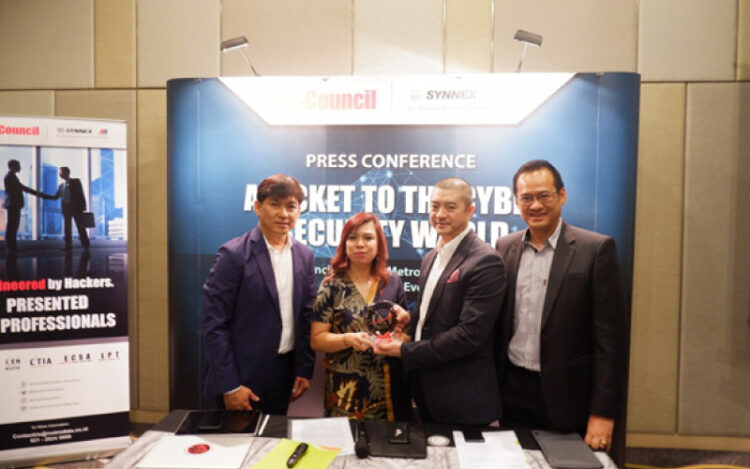
PT Synnex Metrodata, Indonesia, partners with EC-Council to bring Cybersecurity Education to the nation

Jakarta, Indonesia —PT Synnex Metrodata Indonesia (“SMI”), a subsidiary of PT Metrodata Electronics Tbk that focuses on Information and Communication Technology Distribution (“ICT”), today announced its strategic partnership with EC-Council”. In an exclusive press conference at the DoubleTree Hilton, EC-Council and PT Synnex Metrodata Indonesia announced that they would be joining forces to raise awareness on the significance of cybersecurity education. SMI and EC-Council pledged to work together to provide holistic education solutions in cybersecurity through SMI channels in Indonesia.

Read article
CISO MAG study: 1 in 3 CISOs feel the biggest challenge of endpoint solution is its complexity

November 21, 2019: Today, the typical organization has hundreds if not thousands of endpoints: desktops, workstations, laptops, mobile phones, tablets, access points, printers, IP-cams, USB devices, credit card readers, POS devices, servers, cloud VMs, and virtual desktops. The addition of IoT devices will increase the number of endpoints even more. Traditional anti-malware, signature-based, and file-scanning solutions will not be able to keep up and manage all those endpoints. This raised concerns with organizations delving into endpoint security. CISO MAG, an information security news website, and publication from EC-Council conducted a multiple-choice survey, in the month of October 2019 to present new research on the usage of endpoint security solutions. 3 Key takeaways The three prominent findings that stand out in the survey are: The best of both: Half of all companies (53.19%) that participated in this survey are using both EPP and EDR solutions. Endpoint visibility: Almost half of the respondents (46.38%) want real-time endpoint and application visibility. Managed services: Two-thirds (62.55%) said their endpoint solution included managed endpoint detection services. Some vendors are sweetening their offerings by bundling endpoint monitoring and management services. These services offer in-depth or advanced threat hunting, forensics, and remediation services. Another key trend is that endpoint protection is now moving to the cloud, with SaaS-based services for monitoring endpoints. The demand for endpoint security services has increased as cloud security has improved. Traditionally, endpoints were centrally managed from an on-premise server communicating with agents on the endpoints. This shifts the responsibility of managing endpoints out of the enterprise and into the hands of managed security services providers (MSSPs). Here are some key findings of the survey, indicating that many organizations still need to complete their endpoint security deployments. Key Findings More than half the respondents (62.98%) have been using an endpoint security solution for some time. It is surprising to note that 14.89% are not using any endpoint security solution. The rest of the respondents (22.13%) are either in the process of evaluating a solution, implementing a solution, or conducting pilot trials. Almost half the respondents (46.38%) agree that an endpoint security solution offers better or real-time endpoint and application visibility. A quarter of the respondents (25.11%) said there was increased usage of mobile devices and endpoints in their organizations. A fifth (20.85%) agreed there was increased volume and complexity of breaches. More than half (53.19%) are using a combination of EPP and EDR solutions while the rest are using one or the other. Two-thirds (62.55%) said their endpoint solution included managed endpoint detection services, while a little over one-third (37.45%) said they were not using such services. More than half the respondents (52.34%) said the main factor in deciding the type of endpoint solution they want is the technical capability of the solution. A third of the respondents (32.77%) said the biggest challenge is the complexity of deploying, managing, and using endpoint solution. Methodology The online survey was conducted by CISO MAG readers from EC-Council’s database. The respondents represent a cross-section of organizations from over 42 countries. Responses were received from those living in the U.S., U.K., UAE, Singapore, Egypt, and The Netherlands. Entries were also received from islands in the Caribbean Sea, such as St. Vincent & The Grenadines, and Trinidad & Tobago. The survey was prepared in consultation with security experts and industry analysts. Survey Respondent Profile IT Manager/ICT Manager Head of IT/VP IT MIS Manager IT Security Manager Information Security Manager Manager/Head of Network Security Director of Information Security ISO/Information Security Officer Security Operations Officer/Operation Security Manager VP/CISO CIO Security Consultant Cybersecurity/Security Analyst Cybersecurity Architect Cybersecurity Engineer Head of IS and SOC ICT Security, Risk & Compliance Coordinator Head IT, Risk & Security Read the full survey report and the latest issue of CISO MAG here. About CISO MAG CISO MAG is a publication from EC-Council, which provides unbiased and useful information to the professionals working to secure critical sectors. The information security magazine includes news, comprehensive analysis, cutting-edge features, and contributions from thought leaders that are nothing like the ordinary. Within the first year of launch, the magazine reached a global readership of over 50,000 readers. The magazine also has an Editorial Advisory Board that comprises some of the foremost innovators and thought leaders in the cybersecurity space. Apart from this, CISO MAG also presents a platform that reaches out to cybersecurity professionals across the globe through its Summits and Awards and Power List surveys. About EC-Council EC-Council has been the world’s leading information security certification body since the launch of their flagship program, Certified Ethical Hacker (CEH), which created the ethical hacking industry in 2002. Since the launch of CEH, EC-Council has added industry-leading programs to their portfolio to cover all aspects of information security including EC-Council Certified Security Analyst (ECSA), Computer Hacking Forensics Investigator (CHFI), Certified Chief Information Security Officer (CCISO), among others. EC-Council also hosts conferences across the US and around the world, including Hacker Halted, Global CISO Forum, and CISO Summit. For more information about EC-Council, please see https://staging-new.eccouncil.org.

Read article
EC-Council Names World’s Best Certified Ethical Hackers on its Global Leaderboard

Albuquerque, NM; November 1, 2019 – EC-Council, the leading global information security certification body, today announced the launch of the Global Ethical Hacking Leaderboard. The leaderboard will celebrate some of the most accomplished CEHs around the world. Organizations with cybersecurity teams that have a keen eye for the best talent across the world will be able to benchmark the capability of their teams against the absolute best.

Read article
4 realistic perks of having a proactive certified incident handler on-board

Does your firm need a certified incident handler on the team? Incident handlers manage the situation that happens after a cybersecurity attack. They plan, manage, coordinate, and communicate in order to contain and mitigate the attack’s effects. In this article, Tiru Dehariya discusses some of the benefits that come with having an incident handler on board and when to look for when hiring one.

Read article
EC-Council Associate Certifications from Certiport Receive Florida CAPE-Secondary Endorsement for 2019-2020

[8/20/2019, TAMPA, FL] EC-Council and Certiport are pleased to announce that both EC-Council Associate (ECA) certification courses, Cyber Forensics Associate and Ethical Hacking Associate, have been added to the Florida CAPE Industry Certification Submissions Recommended for 2019-2020. EHA and CFA will carry the following Florida Department of Education codes within CAPE:

Read article
C|EH, now in German – EC-Council removes Language Barrier in Cybersecurity Credentialing

Over 220,000 cybersecurity professionals have been trained in EC-Council programs since we embarked on our mission to help improve the global levels of cybersecurity talent. Starting this month, thousands more will get trained in the newly launched German version of the globally recognized Certified Ethical Hacker (C|EH) Exam. “Ethical hacking is a fundamental requirement of every organization or government entity. With the exam now in German, residents of German-

Read article
Deakin University Partners with EC-Council to offer Cybersecurity Courses

Summary: Deakin University partners with EC-Council  to introduce cyber security courses to the students of their degree program, Bachelor of Cyber Security. Deakin University is partnering with EC-Council to integrate EC-Council cyber security certifications into Deakin’s undergraduate program. Students pursuing the Bachelor of Cyber Security from Deakin University will be able to attain four leading industry-recognized credentials including: EC-Council’s Certified Ethical Hacker (C|EH), Certified Network Defender (C|ND), Computer Hacking Forensic Investigator (C|HFI) and EC-Council Certified Security Analyst (E|CSA) . This initiative to bring these globally renowned credentials to Deakin’s students aligns with the Government of Australia’s commitment to mitigating cyber security risks to the nation’s security that results from large scale sophisticated cyber threats. Among the five policies listed in Australia’s Cyber Security Strategy launched in 2016, one of them is the “growth and innovation of cyber security education.” The Academic Centres of Cyber Security Excellence (ACCSE) program is part of the drive for which the Australian government allocated $230 million and further $1.9 million over four years (2016-2017 and 2019-2020) towards the establishment of ACCSE at the university level. “We are integrating EC-Council certifications into our courses because we believe this will allow students to better demonstrate to employers that they have learned the hands-on skills necessary to keep their systems safe, as well as to provide them a pathway to keep improving their skillset after they graduate, by continuing through the EC-Council career pathway.” – Professor Robin Doss, Professor of Information Technology & Deputy Head of School, School of Information Technology, Faculty of Science, Engineering and Built Environment, Deakin University. “This is an important industry-academia collaboration led by Wissen, EC-Council’s exclusive distributor for Australia, to bring EC-Council cyber security certifications to the students at Deakin University. The partnership will benefit the students by allowing them to gain specialized skills in cyber security and acquire leading positions in the Australian cyber security industry. The collaboration will also bring greater opportunities for EC-Council to introduce more cyber security programs and contribute to filling the talent gap in Australia,” – Sean Lim, Chief Operating Officer, EC-Council. About the C|EH and C|HFI programs: C|EH is one of the world’s most advanced ethical hacking courses, covering the most current security domains. In 20 comprehensive modules, the course covers 340 attack technologies commonly used by hackers. It is a hands-on program that teaches the five phases of ethical hacking including, reconnaissance, gaining access, enumeration, maintaining access, and covering your tracks. To beat a criminal hacker, C|EH teaches you must learn their methods. C|HFI presents a detailed, methodological approach to computer forensics and evidence analysis. It is a credential that can help law enforcement personnel, investment bankers, security officers, system administrators, defense and military personnel and anyone concerned with the integrity of the network infrastructure. Both programs are mapped to the NICE framework, accredited by ANSI (American National Standards Institute), and recognized by the DoD (United States Department of Defense). About EC-Council: EC-Council has been the world’s leading information security certification body since the launch of their flagship program, Certified Ethical Hacker (C|EH), which created the ethical hacking industry in 2002. Since the launch of C|EH, EC-Council has added industry-leading programs to their portfolio to cover all aspects of information security including EC-Council Certified Security Analyst (ECSA), Computer Hacking Forensics Investigator (C|HFI), Certified Chief Information Security Officer (C|CISO), among others. EC-Council Foundation, the non-profit branch of EC-Council, created Global CyberLympics, the world’s first global hacking competition. EC-Council Foundation also hosts a suite of conferences across the US and around the world including Hacker Halted, Global CISO Forum, TakeDownCon, and CISO Summit. To learn more about EC-Council, visit https://staging-new.eccouncil.org/ About Wissen: Wissen is the exclusive distributor and sole representative of EC-Council being known as the cyber security competency development arm. More than 80 EC-Council academia and accredited training partners across Singapore and Asia Pacific such as Australia, Hong Kong, Philippines, Myanmar, Cambodia and Vietnam are managed by Wissen. Wissen also works in collaboration with government and local associations to proliferate EC-Council’s cybersecurity courses. About Deakin University: Deakin University is a public university in Victoria, Australia recognized for its innovative teaching, award-winning courses, and world-class facilities. The university offers degree and graduate programs in the streams of health, engineering, commerce, science, cyber security, business, law and more. Deakin aims to be Australia’s premier university driving the digital frontier – to enable a globally connected education for the jobs of the future and research that makes a difference. The university provides a personal and flexible learning experience to their students with their different study methods.

Read article

Dark Web Forensics

You have, no doubt, seen the term ‘dark web’ in various news stories.  However, many people in cybersecurity don’t know much about it, nor how to investigate it.  The dark web is a web of sites that are available only via the TOR network.  Now certainly not all of these are criminal sites. Many are simply discussion boards, political groups, and similar perfectly legal activities. However, the nature of the dark web provides a great deal of anonymity. And that makes it an ideal place for criminal activities.

Read article